
Framework of Practice:
Center Equity
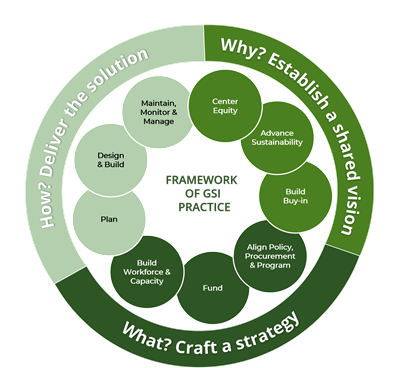
This chapter from the Framework of Practice helps to establish a shared vision for GSI.
Center Equity explores:
- Preparing teams for equitable GSI delivery
- Centering community
- Ensuring project selection, siting, and investments enhance equity
- Designing projects and programs for lasting community benefits;
- Fostering economic stability and wealth building
- Mitigating displacement risks
- Identifying equitable policies and programs
- Addressing racial equity
- Combatting biases in urban planning
- Promoting equitable distribution of assets and benefits
As stated in the Equity Guide for Green Stormwater Infrastructure Practitioners, the rising use of green stormwater infrastructure presents new opportunities for our members to help build toward a world where one’s race, economic status, zip code and other personal and community identities do not predict quality of life. Intentional approaches to green infrastructure program design, project delivery and community engagement help move the needle on all four dimensions of equity — spatial, identity, process and power.
Furthermore, thoughtfully designed green infrastructure can have multiple positive benefits for the physical, economic and social health of our communities. We also have learned from 20 years of collective experience that green infrastructure built without prioritizing or centering community may increase development pressures, contribute to displacement and miss opportunities to improve community cohesion. Public infrastructure has a history of perpetuating inequities through uneven investments that reflect systemic patterns of exclusion and racism, and we have an ethical imperative to course-correct these systems in pursuit of equitable outcomes.

Exchange Research Spotlight: Key Barriers to Centering Equity
As stated in the Equity Guide for Green Stormwater Infrastructure Practitioners, the rising use of green stormwater infrastructure presents new opportunities for our members to help build toward a world where one’s race, economic status, zip code and other personal and community identities do not predict quality of life. Intentional approaches to green infrastructure program design, project delivery and community engagement help move the needle on all four dimensions of equity — spatial, identity, process and power.
Furthermore, thoughtfully designed green infrastructure can have multiple positive benefits for the physical, economic and social health of our communities. We also have learned from 20 years of collective experience that green infrastructure built without prioritizing or centering community may increase development pressures, contribute to displacement and miss opportunities to improve community cohesion. Public infrastructure has a history of perpetuating inequities through uneven investments that reflect systemic patterns of exclusion and racism, and we have an ethical imperative to course-correct these systems in pursuit of equitable outcomes.
Exploring this chapter will answer the following questions:
- How can we prepare our organizations internally to center community?
- How can we center community members as essential partners?
- How can our project siting and design help communities thrive?
- How do we promote economic stability and growth in frontline communities?
Start where you are
The green infrastructure field comprises individuals at various experience levels, so we encourage you to start wherever you are. Whether you are a seasoned professional or a newcomer and whether your organization has a mature or nascent green infrastructure program, you will find useful tools here. The strength of the Exchange lies in the diversity of our experiences and the knowledge we share with one another.
Access the most relevant tool(s) for your personal learning journey: