
Equity Case Study:
Seattle, WA
How Seattle Public Utilities Built Racial Equity with Branch Equity Teams for Inclusive Services
| Region | Pacific Northwest USA | Principle | Prepare to Center Community |
| City | Seattle, WA | Best Practice | Articulate commitment through an equity strategy |
| Population | 750,000 | ||
“My work is easier because of the work done by the EJSE team 16 or 17 years ago. The work has moved so much, and it’s now so much more ingrained in the culture here.”
–Sapan Parekh, Racial Equity Advisor for Seattle Public Utilities
Project Description
Seattle Public Utilities’ (SPU) Environmental Justice and Service Equity (EJSE) team works to realize the goals of the City’s Race and Social Justice Initiative and support SPU in delivering racially inclusive and equitable services. As part of this effort, EJSE stood up several Branch Equity Teams. These teams undergo learning and training, identify opportunities to apply the Racial Equity Toolkit and develop branch-specific work plans reportable to EJSE. Teams seek to involve staff from across the whole organization and are supported by deputy directors who act as executive sponsors, providing important backing from leadership.
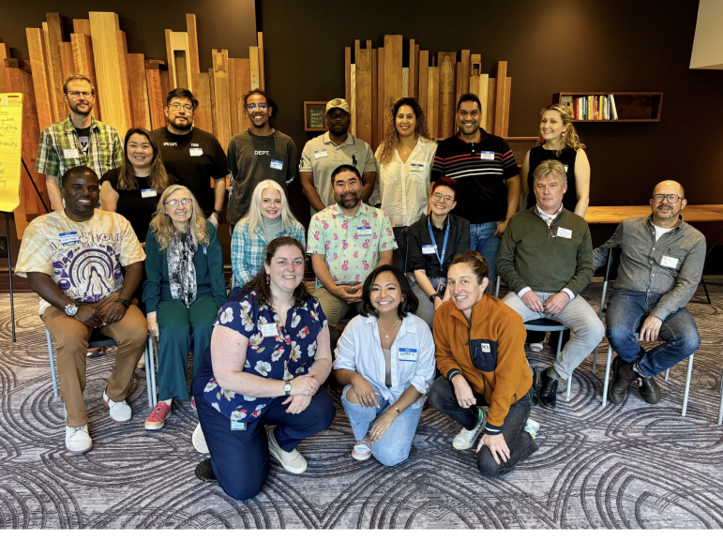
Top Row (left to right): Alexander May, Emily Chow, Temo Hernandez-Vivar, Zane Mohamed, Allen Knight, Azaria Espinoza, Sapan Parekh, Kelsey Quinn; Middle Row (left to right): Michael Turner, Sylvia Cavazos, Lucie Harpster, Kevin Black, Miles Parker, Eric Dyrness, Bill Duyungan; Front Row (left to right): Anne Fried, Linet Bravo, Leslie Webster
Best Practices in Action
The Water Utility Line of Business Branch Equity Team aimed to address disparities in frontline crew demographics and career advancement opportunities, especially for BIPOC employees. They started by revising the hiring process, diversifying interview panels and incorporating equity-focused questions into interviews. Their efforts have garnered significant executive support and are now being integrated into broader HR practices. Hiring managers have a form to complete and get approved to ensure consistent application across the utility. EJSE is actively monitoring the use and impact of these hiring practices which reflects the culture of continuous improvement and dedication to race and social justice. For example, in monitoring impacts, they discovered that the repeated request for a few BIPOC employees to serve on interview panels can lead to fatigue. This highlighted the need for equitable distribution of responsibilities. The EJSE is now exploring policies to support employees who face additional barriers to participating in race and social justice groups like Branch Equity Teams or affinity groups.
Key Learnings
Equitable Hiring Practices
Revising hiring processes to include diverse interview panels and equity-focused questions helps address systemic barriers. However, monitor for unintended impacts that require responsive adaptation to continue advancing equity goals.
Executive Support
Strong leadership investment is crucial for championing and sustaining equity initiatives.