
Equity Case Study:
Oakland, CA
How Oakland, CA Implemented Transparent Evaluation and Community-Driven Response for Equity in Action
| Region | West Coast, USA | Principle | Prepare to Center Community |
| City | Oakland, CA | Best Practice | Act on an equity plan |
| Population | 440,000 |
“My wife has recently been made unemployed and subsequently retired. It has been wonderful to be able to enjoy the streets in a safe way and has made our lives a bit nicer. We are living with less income, but still feel safe and happy. Being able to enjoy the streets has been part of that.”
–An anonymous respondent to the Oakland Slow Streets Program Feedback Form
Project Description
The Slow Streets – Essential Places pandemic response program ran from April 2020 to February 2022. The Oakland Department of Transportation closed 21 miles of streets to create neighborhood space for physical and social activity. Overall, despite the success of the through-street closures in some neighborhoods like North Oakland, OakDOT realized the street closures were not as successful in neighborhoods with the highest concentrations of low-income and BIPOC residents. To learn more, OakDOT launched a survey, disaggregated data by geography and demographics and convened a cohort of community leaders from high-priority neighborhoods to advise on what was — and was not — working.
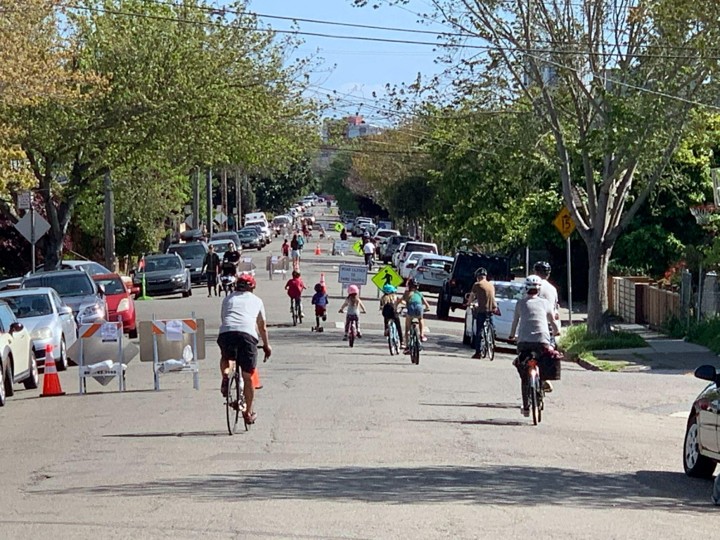
Bicyclists and pedestrians enjoying a Slow Street
Best Practices in Action
To make Slow Streets feel safe enough for most people in priority neighborhoods, OakDOT would need a much higher level of investment in the program. The sentiment in those neighborhoods was that they should be focusing resources on traffic safety concerns, especially on major streets.
After significant feedback and consideration, OakDOT transitioned the program. Their first pivot was using temporary materials to make pedestrian safety improvements at 15 essential services such as health clinics, food distribution hubs, testing sites and grocery stores. Improvements included safety islands, lane closures at uncontrolled crosswalks, automatic walk phases at traffic signals and signage to raise awareness of pedestrian safety at essential services (“Go Slow – It’s Essential”).
Finally, after two years of maintaining the temporary pandemic response program, OakDOT removed the street closures and pivoted to a more permanent vision for Slow Streets. They planned for a citywide network of streets designed for walking, biking and jogging, and for getting around with low-powered electric vehicles. Slow Streets are envisioned as another layer of Oakland’s transportation system to complement major streets, transit and freeways. Oakland’s first demonstration Slow Street, 8th Street in West Oakland, finished construction in 2024.
Key Learnings
Community Feedback is Crucial
The success of street closures varied significantly between neighborhoods, emphasizing the need for equitable approaches that consider the specific needs of low-income and BIPOC communities.
Data-driven decision making
Disaggregating survey data by geographic and demographic factors provided valuable insights into how different communities were impacted by the program.