
Equity Case Study:
San Francisco, CA
How San Francisco, CA Incentivized Equity-Driven Design with the Green Infrastructure Grant Program
| Region | West Coast, USA | Principle | Deliver Benefits |
| City | San Francisco, CA | Best Practice | Optimize for community priorities |
| Population | 808,000 | ||
| Partners | San Francisco Unified School District, San Francisco Planning, San Francisco Recreation and Parks | ||
“We are so excited that our schoolyard can contribute to the health of San Francisco watersheds while creating an interactive play space that encourages our students to learn about the water cycle”
–Principal, RL Stevenson Elementary School
Project Description
San Francisco Public Utilities Commission’s (SFPUC) Green Infrastructure Grant Program funds the design and construction of green infrastructure on large properties and in the public right-of-way. The SFPUC created a set of objective criteria for evaluating applications to the program, focusing on specific, defined benefits tailored to San Francisco’s unique needs. Applicants were required to achieve at least two co-benefits from a predefined list, which included categories like education, access to open space, biodiversity, water reuse and environmental justice. These criteria were developed in consultation with San Francisco Unified School District, San Francisco Planning and San Francisco Recreation and Parks to ensure alignment with local priorities.
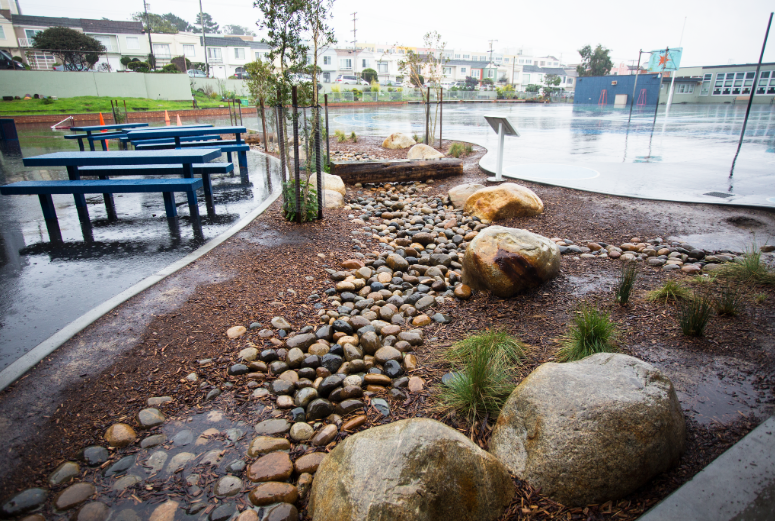
Stormwater Schoolyard, RL Stevenson Elementary School
Best Practices in Action
Throughout the program, the SFPUC engaged with current grantees to gather feedback, refining the approach to ensure that the guidelines fostered more thoughtful and creative projects. This iterative process led to the removal of less impactful co-benefits (e.g., groundwater recharge) and replacement with co-benefits like climate resilience, community engagement, collaboration and placemaking. This approach helped teams more fully integrate co-benefits into the design rather than treating them as mere checkboxes. The competitive nature of the grant cycle has further encouraged applicants to think deeply about how to incorporate co-benefits in innovative and cost-effective ways.
For instance, in the case of biodiversity, applicants earn points by identifying specific native species and incorporating design elements that support these species, aligned with the city’s local biodiversity ordinance. Environmental justice was another key focus, with the SFPUC providing applicants the flexibility to define what environmental justice meant for their projects while offering a scoring framework that allowed for qualitative assessment.