
Sustainability Case Study:
Toronto, Canada
How Waterfront Toronto Partnered with Mississaugas of the Credit First Nation to Create a Climate Resilient Park with Indigenous Placekeeping
| Region | Canada | Principle | Collaborate to advance shared sustainability and climate resilience goals |
| City | Toronto, ON | Best Practice | Engage in watershed-level intergovernmental initiatives |
| Population | 3 Million | ||
| Partners |
Waterfront Toronto and Mississaugas of the Credit First Nation |
“It’s probably a generational project to repair the wounds and damage from the history of colonialism, residential schools.”
– Shannon Baker, Project Director
Project Description
Waterfront Toronto—a tri-government partnership funded by Canada, Ontario, and the City of Toronto—is spearheading the transformation of the Toronto Waterfront. A primary focus of this revitalization is renaturalizing the mouth of the Don River, a historically industrialized area prone to severe flooding during extreme weather. By restoring natural river dynamics and flood protection, this ambitious initiative is transforming 500 acres of previously vulnerable land into vibrant new urban communities.
At the centerpiece of this $1.4 billion effort lies Biidaasige Park, a 60-acre naturalized greenspace designed in deep partnership with the Mississaugas of the Credit First Nation, the treaty holders and traditional stewards of the land. Moving far beyond standard legal consultation, Waterfront Toronto collaborated directly with First Nation leaders and Indigenous architects to deeply embed Indigenous placekeeping throughout the park. Visitors will encounter traditional Dodem animal sculptures, native flora, and educational signage sharing the rich history of the land. In a unique fusion of living art and traditional wayfinding, Indigenous youth will shape “marker trees” by bending young branches as they mature over time.
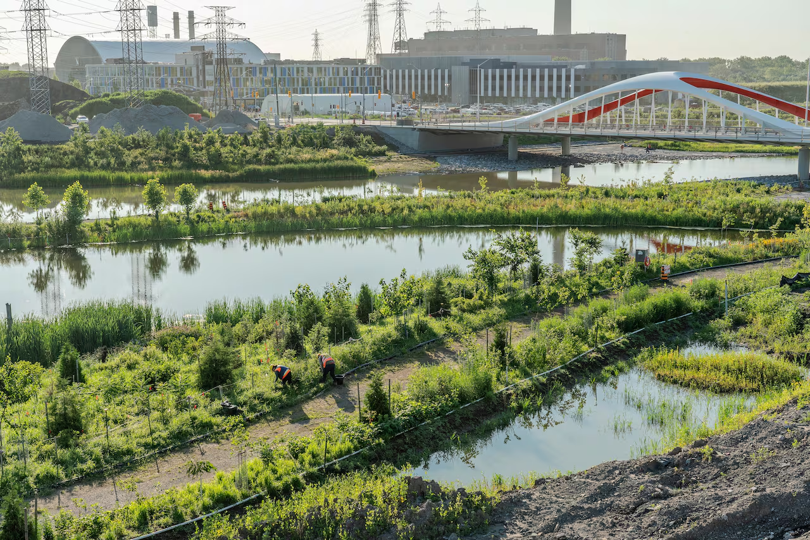
This part of the formerly industrialized Toronto waterfront has been renaturalized with Biidaasige Park. (Credit: Vid Ingelevics, Ryan Walker/Waterfront Toronto)
Best Practices in Action
Building genuine trust required patience and long-term commitment. Waterfront Toronto spent years participating in First Credit community events before formalizing their relationship through a Memorandum of Understanding (MOU). This intentional foundation laid the groundwork for meaningful, ongoing collaboration and an active journey toward decolonizing municipal practices.
Under the MOU, First Credit knowledge holders and Indigenous professionals are fully compensated for their time and expertise. First Credit representatives actively co-designed the park from the outset rather than merely reviewing pre-packaged plans. During construction, a dedicated field liaison oversaw site work, and Waterfront Toronto created dedicated private spaces for First Credit members to conduct traditional ceremonies at significant milestones throughout the project lifecycle.
Key Learnings
Invest in relationships before seeking collaboration
Waterfront Toronto earned trust by consistently showing up at First Credit events over several years prior to requesting project partnerships.
Embed community wisdom throughout the entire project lifecycle
Indigenous leaders guided every stage of development, from initial concept design through active construction and ongoing stewardship.
Fairly compensate place-based expertise
The project budget explicitly funded First Credit advisors, field liaisons, and Indigenous youth involved in implementation.
Other Recommendations
- Incorporate place-based expertise in GSI planning.
- Engage in government-community collaboration through stewardship programs.
- Support community resilience through workforce development and local hiring.