
Sustainability Case Study:
Greater Milwaukee, WI
How the Milwaukee River Watershed Conservation Partnership Bridges Urban and Rural Land
| Region | Great Lakes | Principle | Align with established sustainability and climate resilience goals |
| City | 29 communities in the Greater Milwaukee Area, WI | Best Practice | Align GSI site selection and design with climate resilience and other community goals |
| Population | 1+ Million | ||
| Partners | Milwaukee Metropolitan Sewerage District (MMSD),
USDA Natural Resources, Conservation Service (NRCS) Agricultural producers, Land trusts, State and local governments |
“We have to work across the entire watershed, and a lot of the watershed is very rural.”
–Kristin Schultheis, Milwaukee Metropolitan Sewerage District Senior Project Planner,
speaking to ASCE Environmental and Water Resources Institute
Project Description
The Milwaukee River watershed is experiencing degraded water quality, partly due to phosphorus, sediment, and bacteria from agricultural runoff. The Working Soils program uses the land conservation model to mitigate runoff pollution. The program establishes voluntary agricultural land easements on active farmland with natural hydric systems (e.g., wetlands and vegetated corridors), and prime and unique soils connected to the watershed. Willing landowners are paid for the easement, which maintains the farmer’s land ownership and right to farm the land. USDA-NRCS and the farmer collaborate to develop and fund a land management plan to improve soil health and water retention. Conservation practices may include no-till farming/cover crops, field borders, pollinator plantings, grassed waterways, vegetated buffers, and nutrient management. The farmer benefits by building healthier and more productive soils that have an improved ability to retain nutrients, water, and topsoil. The local community benefits by preserving the agricultural character of the land. And downstream urban communities benefit from improved water quality and reduced flooding.
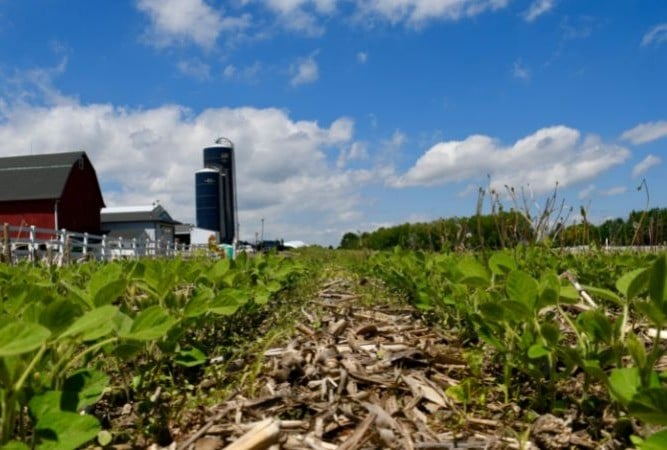
To slow soil erosion, farmers in rural communities in the Greater Milwaukee area plant native pollinator seed mix to establish perennial prairie strips. Credit: Milwaukee Metropolitan Sewerage District
Best Practices in Action
The Metropolitan Milwaukee Sewerage District leverages its unique regional, watershed-level jurisdiction to work upstream of built out urbanized land. This private property GSI program offers co-benefits that are not always considered in urban programs. For example, soil health and nutrient retention may not be a high priority for urban areas, but they have important economic benefits for farmland. Landowner engagement is essential to the siting and design of these GSI practices, as the farmer retains the right to farm the land. And this type of GSI preserves community character, rather than risking “green gentrification” through new development.
Key Learnings
Work upstream of flooding
As noted by the Wisconsin Wetlands Association, “wetlands in the upper portion of a watershed are particularly important for managing the timing, volume, and direction of surface and groundwater flow within the rest of the watershed.”
Seek win-win solutions
Rather than asking farmers to take prime farmland out of production to install passive GSI, the program offers an incentive and support to improve soil health for better farming. The easement payment can also provide financial stability for the farmer, as an alternative to selling the farm for suburban development which would increase surface runoff.
Other Recommendations
- Engage in watershed-level intergovernmental initiatives.
- Protect and enhance existing high-quality natural areas and greenspace.
- Recognize trees and soil as valuable assets for mitigating and adapting to climate change.