
Design & Build Case Study:
Portland, OR
How Portland, Oregon Integrates Operations and Maintenance Early in Green Infrastructure Design Processes
|
Region |
Northwest |
Principle |
Collaborate on Design |
|
City |
Portland, OR |
Best Practice |
Involve operations and maintenance early |
|
Population |
636,000 |
||
|
Partners |
City of Portland, Multiple internal Environmental Services work groups |
||
“It is short-sighted to not include your end users in your design process.”
– Kris Hikari, City of Portland Environmental Specialist
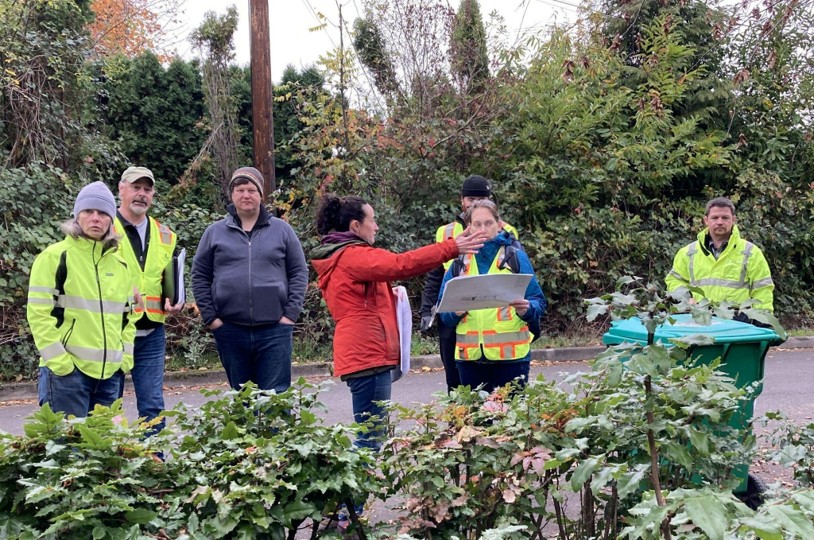
Collaborative design site visit with City of Portland Bureau of Environmental Services staff
Project Description
In Portland, Oregon, the Bureau of Environmental Services (BES) established a structured process to facilitate ongoing, active participation from the Operations & Maintenance (O&M) team in the development of green infrastructure projects. From the outset, O&M representatives are a key partner throughout the process. O&M teams join the Plan Review Committee at 30%, 60%, and 90% design milestones and contribute to the Stormwater Management Manual updates to align design assumptions with observations from the field and long-term maintenance needs., As “end users,” O&M ensures facilities are built to specifications for optimal functionality, ease of maintenance, and maximum plant vitality by partnering with construction management and inspection staff.
Best Practices in Action
In 2018, the city initiated an extensive review and update of policies and design details pertaining to green stormwater facilities in preparation for the release of the City’s 2020 Stormwater Management Manual. Led by Ivy Dunlap, a City of Portland Landscape Architect, the process brought multi-disciplinary teams together and led to a watershed moment where participants recognized the need to foster more dialogue on how the work of the various teams overlaps. These foundational conversations led to strong recognition of the need to involve multiple disciplines, especially O&M, in the design process. While this wasn’t the first time that O&M had a seat at the table, this updated process helped to solidify the participation of O&M in reviewing policy changes, technical specifications, and project scopes alongside designers.
O&M participation in decision making has brought about several positive outcomes. Through their involvement, key considerations such as maintenance access requirements, soil blend specifications, plant health needs, and other maintainability criteria have been embedded into standard design details and specifications. For example, during the design of a new capital project, O&M identified the need to capture heavy sediment loads from a major arterial street with significant slope to keep vegetation from continually getting buried between maintenance visits. O&M proposed adding sediment forebays to capture and settle sediment and debris from stormwater runoff before flowing into the vegetated facilities, thus protecting the plants and function of the facility and making it easier for O&M crews to remove the sediment. Based on the initial performance of this solution, the City of Portland soon after codified this sediment management solution as a new requirement for heavy traffic and sediment arterials, as well as for curb extension facilities, in the aforementioned Stormwater Management Manual. Subsequent experience of O&M team revealed that the new forebay standard was sized too small for the heavy sediment load on the street with the pilot facilities. Those observations will inform future project designs and standard updates.
Now that O&M involvement though the design process is well established, Portland is now pivoting to focus on the green infrastructure construction process where they are working to identify gaps and opportunities to better integrate the O&M team more effectively into this aspect of green infrastructure implementation.
Key Learnings
Embed O&M in design reviews
Inviting O&M to progressive design checkpoints prevents costly rework. By seeking O&M input at the outset, teams can reach early agreement on maintainability criteria, such as maintenance access clearances and plant selection.
Build on past efforts
Prior processes to update stormwater management manual and design guidance processes built organizational relationships and collaborative models. The team was able to build off this momentum to formalize this collaboration approach in design processes.
Standardize learnings
Frontline O&M feedback on sediment challenges led to the adoption of sediment forebays, a low-maintenance solution that now informs Portland’s standard green infrastructure toolbox.