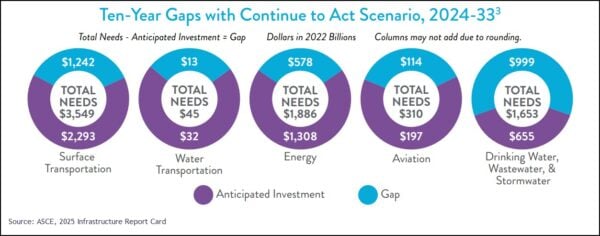
America has a well-documented stormwater crisis. In giving stormwater infrastructure in the U.S. a grade of D in its 2025 Infrastructure Report Card, the American Society of Civil Engineers noted that, over the last decade, the length of impaired rivers and streams has increased from about 424,000 miles in 2010 to more than 588,000 miles in 2019, and in 2022, more than 703,000 miles. The most recent MS4 needs assessment survey reported funding and financing strategies, asset management and green infrastructure/innovative BMPs as areas where nearly 600 respondents from municipalities across the U.S. had high priority needs for technical assistance. A recent review of the Clean Water Act by the Water Center at Penn noted that “The Act’s narrow focus on water quality, to the exclusion of water quantity and flood resilience, has left it ill-equipped to address the principles of integrated water management often referenced as “One Water” now. In short: Infrastructure is failing us, municipal stormwater managers are struggling to cope with a host of increasingly overwhelming challenges, and our laws and regulations are outdated.
These are among the challenges fueling the work of the National Stormwater Leadership Coalition, a cross-sector partnership convened by American Rivers and the National Municipal Stormwater Alliance. The Coalition brings together leaders from municipalities and utilities, community and environmental organizations, universities and research institutions, professional associations, and the business community to develop a consensus-based National Stormwater Solutions Agenda addressing four areas: (1) data, research, and technology; (2) regulatory and legislative policy; (3) sustainable funding; and (4) community and municipal needs.
Through facilitated workgroups across the four focus areas, advisory groups, and a cross-sector Steering Committee, participants will identify common ground while ensuring that the agenda reflects the different experiences and needs of regulated communities, advocates, researchers, practitioners, and the communities most affected by flooding and water pollution. I serve on the Steering Committee and I am co-chairing the workgroup on community and municipal needs with Exchange members Angela Gallardo (King County Washington) and Kennedy Moore (Water Collaborative of New Orleans). Other Exchange members serving on workgroups include: Daniel Apt (Olaunu), Heather Himmelburger (Southwest Environmental Finance Center), Caroline Koch (WaterNow Alliance), Frana Milan (Seattle Public Utilities), Laurie Larson Pugh (Washington Stormwater Center), David Ritter (NEORSD), Meredith Upchurch (Washington, DC DOEE), Jena Voss (Alliance for the Great Lakes), and David Wood (Chesapeake Stormwater Network). We will be seeking input from more Exchange members over the next few months through an upcoming survey and listening session. The resulting agenda, scheduled to launch at the April 2027 National Stormwater Policy Forum in Washington, D.C., will offer a shared platform for improving water quality, strengthening stormwater programs, addressing localized flooding, and delivering more equitable and climate-resilient benefits to communities nationwide.
I am so pleased to have so many Exchange members from across sectors contributing to this important effort. Please reach out to me at barbara@giexchange.org with any thoughts or questions you may have about this work.