
Centering Equity
The Equity Journey: Principles & Practices
We have distilled members’ lessons learned into a representative successful journey toward centering equity:
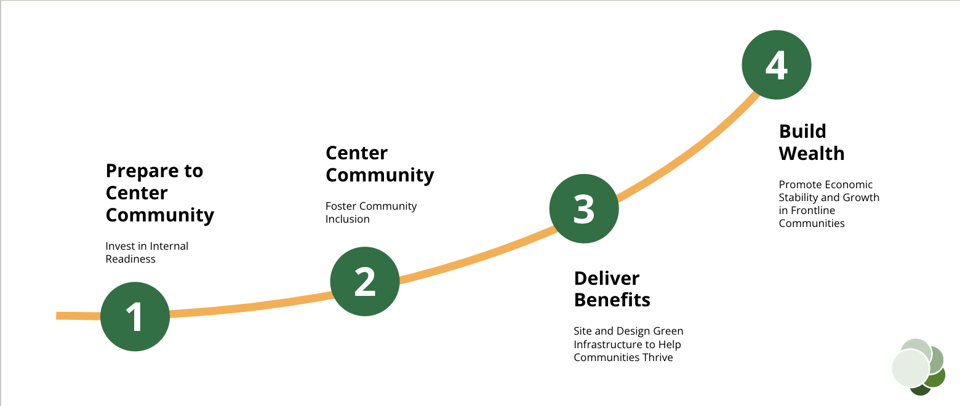
The journey shown here highlights the following fundamental principles — and their associated best practices — for centering equity:
Principle 1: Prepare to Center Community
Invest in internal readiness — starting with leadership buy-in — by applying the following best practices:
Articulate commitment through an equity strategy.
Encourage leadership to state a clear commitment to supporting the team’s internal work to advance equity and develop an equity strategy with a public reporting plan.
Example: How Seattle, WA Built Racial Equity with Branch Equity Teams
Act on an equity plan.
Assess the organization’s current performance against the equity strategy, including organizational readiness to center community. Develop an action plan to implement the equity strategy. Throughout the process, create safe spaces for honest dialogue. At the same time, implement a Diversity, Equity and Inclusion (DEI) strategy to hire and retain a diverse workforce that reflects the community.
Enable equity benefits through budget and timeline flexibility.
Prepare to adaptively manage project budgets and timelines. Take into account the potential equity improvement value of a project and the resources and timeline needed to realize that potential and move at the speed of trust. Dedicate staff positions and resources to lead community engagement.
Principle 2: Center Community
Foster community inclusion by applying the following best practices:
Listen first.
Be present in communities without asking for anything and listen. Make space for owning past harms. Prioritize community-led science and Traditional Ecological Knowledge into community plans and project design.
Develop and implement a community collaboration strategy.
Develop and implement a strategy grounded in a robust discovery process that engages representative community members in accessible, engaging and culturally relevant ways. Compensate and credit communities for their time and expertise. Engage community stakeholders as essential and informed partners from the beginning to co-design the infrastructure and the outreach strategy. Consistently engage community stakeholders throughout each program and project lifecycle.
Principle 3: Deliver Benefits
Site and design green infrastructure to help communities thrive by applying the following best practices:
Site green infrastructure with an equity lens.
Build green infrastructure in areas with the greatest potential to advance equity (e.g., preventing future inequities due to climate risks and hazards). Use both local equity data (e.g., CDC’s Social Vulnerability Index) and community input to support siting decisions.
Examples:
How Raleigh, NC Funded Green Stormwater Solutions Through Rainwater Rewards
Optimize for community priorities.
Center community collaboration and share leadership throughout design and development to identify and design for prioritized community benefits. Refine and apply technical design standards to articulate and promote design choices that advance equity (e.g., vegetative green infrastructure) . Include project celebrations that build a sense of community pride and ownership.
Example:
How San Francisco, CA Incentivized Equity-Driven Design with the Green Infrastructure Grant Program
Follow through on promises throughout construction and maintenance.
Ensure that construction quality delivers on the benefits and priorities that were agreed on in dialogue with impacted community stakeholders.
Principle 4: Build Wealth
Promote economic stability and growth in frontline communities by applying the following best practices:
Create an anti-displacement plan and standards.
Develop an anti-displacement plan for neighborhoods impacted by the program/project with guidance from displacement experts. Consider ways the program/project can better serve the existing community and avoid contributing to their displacement. This may require collaborating with peer agencies and community-based organizations to advocate for broader anti-displacement policies and plans. Adopt anti-displacement design standards.
Examples:
How Atlanta, GA Partnered to Anchor and Uplift Community with Rodney Cook, Sr. Park
Create a program to develop career pathways.
Leverage the multiple benefits of green infrastructure to foster social enterprises and workforce cooperatives that alleviate existing burdens and stimulate local economies. Conceptualize and pitch a career pathways program to leadership. The plan should seek to eliminate barriers for SWMBE firms, community-based organizations (CBOs), local and hyper-local hiring and sourcing, and support low-capacity firms in meeting qualification requirements. Collaborate to integrate a green infrastructure workforce program approach into overarching agency workforce programs, if possible.